
Laravel vs. Node.js in 2027: Which Would I Choose to Build an AI SaaS?

Imagine you're building an AI SaaS application that lets customers upload documents, ask questions, generate reports, and pay for monthly subscriptions.
You have two options: Laravel with PHP or Node.js with TypeScript.
Which would you choose?
The obvious answer might be Node.js because JavaScript has a strong AI tooling ecosystem. But an AI SaaS is rarely just an interface connected to an AI model. It also needs authentication, billing, database management, background processing, usage limits, security, and reliable deployments.
Those requirements can consume more engineering time than the AI integration itself.
If I were planning an AI SaaS launch for 2027, I'd choose Laravel for most conventional SaaS products. But for certain real-time, AI-intensive applications, I'd seriously consider Node.js.
Here's how I'd make that decision, based on the capabilities available in late 2026 and the engineering trade-offs that will continue to matter in 2027.
Laravel vs. Node.js: What Are We Actually Comparing?
First, there's an important distinction.
Laravel is a full-stack PHP framework. It provides an established structure for routing, database operations, authentication, authorization, background jobs, testing, and other common application requirements.
Node.js is a JavaScript runtime, not a framework.
To build a comparable backend with Node.js, you'd typically combine it with a framework such as Express, Fastify, or NestJS, along with database tooling, authentication, validation, and job-processing libraries.
That isn't necessarily a disadvantage. It gives developers more freedom to select individual components.
But freedom introduces decisions, dependencies, and maintenance responsibilities.
For an AI SaaS, I would evaluate five things before selecting either stack:
How much conventional SaaS functionality needs to be built?
Does the AI feature require long-lived connections or streaming?
Will AI processing happen during HTTP requests or in background jobs?
Which language and ecosystem does the team know best?
How much operational complexity can the business afford?
Notice what's missing: a blanket claim that one technology is faster.
Without a representative workload, deployment configuration, and benchmark methodology, runtime performance comparisons tell us very little about which stack will deliver a better product.
And when much of the response time comes from waiting for an external AI provider, differences in application runtime performance may not be the primary bottleneck.
Why I'd Choose Laravel for Most AI SaaS Products
Consider an AI-powered document analysis platform for small businesses.
Customers register, choose a subscription, upload documents, generate summaries, and access their previous reports.
The AI feature is central to the product, but most of the backend is familiar SaaS engineering.
That's where Laravel becomes attractive.
1. Laravel reduces the amount of application infrastructure you need to assemble
Laravel already provides conventions and tooling for many of the responsibilities surrounding an AI feature.
You can use Eloquent for database operations, policies for authorization, queues for background processing, and Laravel's testing tools to verify application behavior.
This matters because early-stage SaaS development is largely about reducing unnecessary complexity.
A small team doesn't benefit from assembling five libraries to solve a problem the chosen framework already handles coherently.
Laravel won't eliminate architectural decisions, but it provides a consistent foundation.
For a product that needs customer accounts, organization-level permissions, subscriptions, reports, and an administrative dashboard, that foundation can make the codebase easier to develop and maintain.
There is one important qualification: Laravel doesn't automatically provide secure multi-tenant isolation or correct business-specific authorization. Those rules still need to be designed, implemented, and tested.
2. Laravel is no longer an outsider in AI development
One argument frequently made in favor of Node.js is that PHP lacks a comparable AI ecosystem.
That argument needs updating.
Laravel introduced its first-party AI SDK in 2026. According to the Laravel AI SDK documentation, it supports functionality including AI agents, structured outputs, streaming, tool calling, embeddings, and integrations with multiple AI providers.
For Laravel developers, this changes the experience of building AI-powered features.
Instead of writing and maintaining separate low-level integrations for every provider, developers can use a consistent Laravel-oriented interface for supported operations.
The SDK also integrates AI workflows with familiar framework concepts, including queues and testing.
That doesn't mean Laravel suddenly has identical library coverage to the JavaScript ecosystem. Provider-specific features, SDK maturity, compatibility, and ecosystem depth still deserve evaluation.
But it removes much of the practical justification for switching languages simply to call an AI model.
3. Background processing is a natural fit
Imagine a customer uploads a 100-page document for analysis.
The application may need to extract text, divide it into sections, generate embeddings, call an AI provider, and save a report.
Trying to complete that entire workflow during one HTTP request introduces timeout and reliability concerns.
A more maintainable approach would be:
Accept the upload and validate its type, size, and access permissions.
Save the document and create a processing record.
Dispatch a background job.
Process the document, call the AI provider, and persist the results.
Update the processing status and notify the customer when the report is ready.
Laravel's queue system supports background jobs using drivers such as Redis, Amazon SQS, and databases.
However, queue support alone doesn't make AI processing reliable.
You still need appropriate job timeouts, bounded retries, failure monitoring, and protection against duplicate processing. External AI calls can succeed even when the application fails before saving the result, so retry behavior must be designed carefully.
For a SaaS product whose AI features operate mainly through asynchronous workflows, Laravel offers a practical foundation.
Where Node.js Has a Stronger Case
I wouldn't automatically choose Laravel for every AI SaaS.
Some applications have requirements that make Node.js particularly attractive.
1. Real-time AI applications
Imagine an AI-powered collaborative workspace where users interact continuously with an assistant.
The application streams generated responses, maintains live connections, updates shared documents, and coordinates multiple asynchronous services.
Node.js is well suited to this kind of I/O-heavy workload.
Its event-loop architecture allows the runtime to handle asynchronous operations without dedicating a separate application thread to every waiting network request. The official Node.js documentation explains both this advantage and the risks of blocking the event loop.
For example, a Node.js application can receive streamed AI output and forward it to connected clients while continuing to process other non-blocking operations.
The official OpenAI JavaScript and TypeScript SDK supports streaming responses, making this workflow relatively natural to implement.
But there's an important distinction.
Node.js doesn't make the AI model generate responses faster. It provides a useful execution model for handling concurrent network activity and delivering those responses.
And Laravel isn't incapable of streaming.
Laravel supports streamed HTTP responses and Server-Sent Events, while Laravel Reverb provides WebSocket capabilities.
The decision is therefore about your application's connection patterns, deployment architecture, and team's familiarity with the technology—not whether PHP can stream AI responses.
2. A TypeScript-first engineering team
Suppose your frontend uses React or Next.js and your developers already work extensively with TypeScript.
Using TypeScript on the backend may simplify hiring, shared data contracts, validation conventions, and movement between frontend and backend tasks.
For a small product team, that consistency can be valuable.
It may also make sense when the product relies heavily on JavaScript-based AI libraries, agent tooling, or integrations that expose their newest capabilities through TypeScript first.
However, sharing a programming language doesn't automatically produce a simpler system.
You still need to establish good architectural boundaries, validate API inputs, manage dependencies, and maintain reliable background workers.
A poorly structured Node.js application can become just as difficult to maintain as a poorly structured Laravel application.
3. Applications with highly customized asynchronous workflows
Some AI products involve complex event-driven interactions rather than conventional request-and-response business features.
Examples include applications that coordinate multiple live AI sessions, continuously consume external event streams, or maintain many simultaneous client connections.
Node.js can be a sensible foundation for these systems, provided the team understands event-loop behavior, cancellation, backpressure, and resource management.
CPU-intensive operations are a different matter.
Large local document transformations, image processing, or computationally expensive workloads can block the Node.js event loop if implemented carelessly. Such work may require worker threads, separate processes, or specialized processing services.
Node.js is not automatically better for every workload described as AI.
What Actually Determines the Cost of Building an AI SaaS?
When choosing a stack, developers often focus on development speed.
Business owners eventually care about total operating cost.
For an AI SaaS, the backend framework is only one part of that equation.
AI provider costs
Every generated response, embedding operation, or tool-assisted workflow can consume paid resources.
A system that repeatedly submits unnecessary context or permits unlimited retries can become expensive regardless of whether its backend uses Laravel or Node.js.
I'd prioritize usage metering, subscription quotas, request limits, and clear cost attribution from the beginning.
Reliability and failure handling
AI APIs can return errors, enforce rate limits, take longer than expected, or become temporarily unavailable.
A production application needs appropriate timeouts, retry policies, cancellation handling, and useful error reporting.
For paid operations, idempotency becomes particularly important: an automatic retry should not create duplicate customer charges or duplicate application records.
AI-generated content also needs validation before it can influence sensitive business decisions or execute privileged actions.
Neither Laravel nor Node.js solves those problems automatically.
Maintenance and team productivity
The cheapest initial implementation isn't always the cheapest system to operate.
Suppose a team of three experienced Laravel developers can build and maintain the product using familiar tools.
Switching to Node.js solely because the product includes AI could introduce unnecessary delivery risk and learning costs.
On the other hand, if the entire team is experienced with TypeScript, introducing Laravel may be an equally questionable decision.
The strongest technical choice is often the one that minimizes unfamiliar complexity while meeting the product's requirements.
That becomes especially important for startups, where engineering time is limited and requirements change frequently.
My Choice for a 2027 AI SaaS
If I were starting an AI SaaS project targeting a 2027 launch, I would make the decision based on the product's primary workload.
For a conventional B2B AI SaaS, I'd choose Laravel.
That includes products such as AI-powered reporting platforms, document processing systems, customer-support tools, content workflow applications, and business automation software.
These applications typically require substantial account management, billing, authorization, database operations, and background processing.
Laravel provides a coherent foundation for that work, and its AI SDK makes integration with supported AI providers more approachable.
For a real-time, TypeScript-heavy AI product, I'd lean toward Node.js.
That includes products where persistent connections, interactive streaming, collaborative experiences, or JavaScript-first AI tooling are central to the architecture.
I'd choose an appropriate Node.js framework, establish clear service boundaries, and design background processing rather than assuming asynchronous code alone solves reliability.
For applications combining both requirements, a hybrid architecture can also be reasonable.
Laravel could manage authentication, subscriptions, organizational data, and business workflows, while a specialized Node.js service handles a demanding real-time interaction layer.
But I wouldn't begin with two backend stacks unless there were a measurable or clearly demonstrated need. Splitting a small application introduces another deployment, more observability work, cross-service authentication, and additional failure modes.
My decision rule is simple: choose the stack that makes the difficult, recurring parts of your product easier—not the one that makes the AI demo look more impressive.
A Laravel application with a well-designed AI integration can be an excellent SaaS architecture. A Node.js application with sound boundaries and reliable asynchronous processing can be equally successful.
By 2027, the most important choice won't be PHP versus JavaScript in isolation. It will be whether the technology fits the workload, the team can maintain it, and the business can operate it sustainably.
Projects to explore next
Source-code projects from the KritiMyantra catalogue. Check each project's details before buying.
Flask Authentication System (Free Version) - Kritim Yantra
🛠 Features✔ Google & GitHub Authentication✔ User Registration & Login✔ Profile/Dashboard Access✔ Secure & Mi...

Flask Blog CMS with Admin Dashboard — Python Source Code
A Flask-based blogging website with a built-in admin dashboard. Manage articles, images, categories, tags and featured p...
Laravel 12 + ReactJS Starter Kit: Add Multi-Language Support (Arabic, English, Spanish) with Blog CRUD
🚀 Installation & Setup Download & Extract Get the ZIP from kritimyantra.com and extract it. Includes preconfigu...
Preparing for Laravel 14: PHP 8.4, Symfony 8, and Breaking Changes You Can Investigate Now
The next Laravel upgrade is not just about framework compatibility. It is an opportunity to discover how much your application dep...
Laravel 14 Release Date: What's Confirmed for 2027
Laravel 14 is already being discussed, but there is an important difference between knowing when a framework is likely to arrive a...
Laravel 14 and PHP 8.4: Why Symfony 8 Matters
Laravel 14 is expected to raise its minimum PHP requirement to 8.4. At first glance, that might look like another routine version...
Laravel 14 Upgrade Risks: Eloquent, Queues and Cache
A Laravel application can pass its test suite, boot successfully after an upgrade, and still behave differently in production. An...
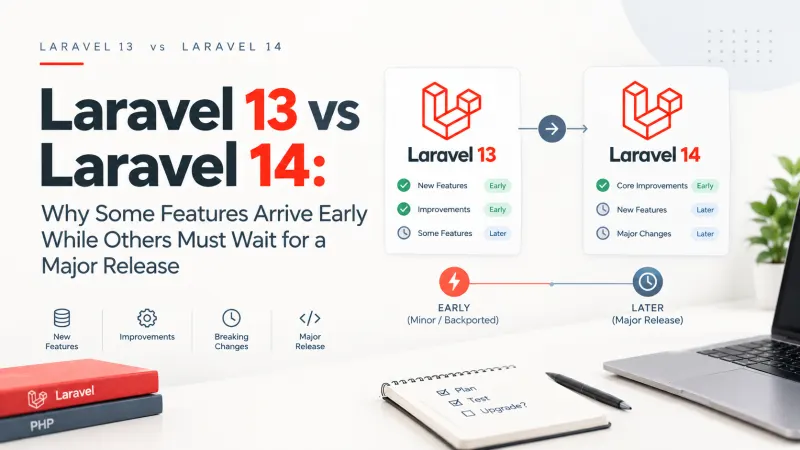
Laravel 13 vs Laravel 14: Why Some Features Arrive Early While Others Must Wait for a Major Release
One interesting thing about Laravel is that some genuinely useful features appear in ordinary framework updates, while seemingly s...
Will AI Replace Laravel Developers by 2030? Here's What I'd Tell a Junior Developer Today
An AI coding agent can generate a Laravel controller, Eloquent model, migration, API resource, and a reasonable first draft of the...
Comments
No comments yet. Be the first to comment.
Sign in to join the discussion.