
Laravel 14 and PHP 8.4: Why Symfony 8 Matters

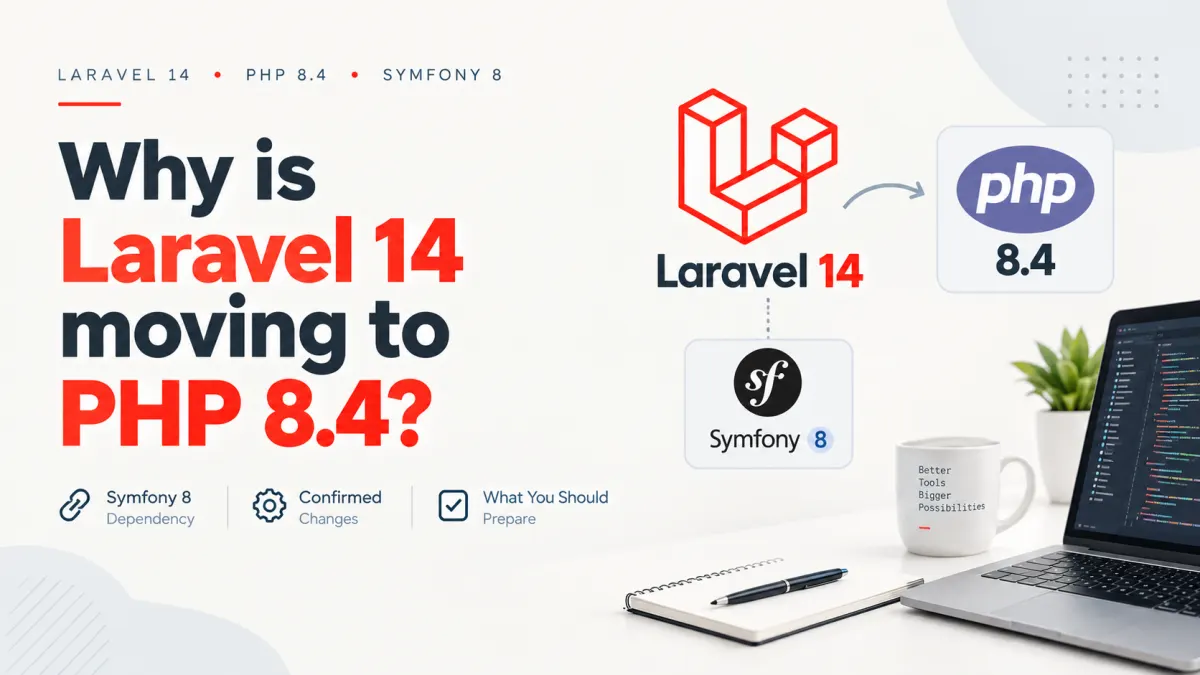
Laravel 14 is expected to raise its minimum PHP requirement to 8.4. At first glance, that might look like another routine version upgrade. But the more interesting reason is found outside Laravel itself.
Symfony 8 is a major factor behind Laravel 14's move to PHP 8.4.
This isn't just speculation based on release schedules. Laravel's own development history explicitly connects the PHP requirement to Symfony 8, and the current framework development branch already reflects that decision.
For developers maintaining Laravel applications, this is worth understanding. A framework upgrade isn't always driven by changes to the framework's public API. Sometimes, the dependencies underneath it determine which runtime versions remain supported.
And Laravel 14 provides a particularly clear example.
Laravel 14's PHP 8.4 Requirement Is Already in Development
On March 5, 2026, Laravel merged a pull request titled Prepare master branch for Laravel 14.
One of the changes was removing PHP 8.3 support.
The pull request explicitly identified Symfony 8's PHP 8.4 minimum requirement as the reason.
Looking at the Laravel framework's current master branch, the composer.json file declares:
"php": "^8.4"
The framework also requires Symfony components from the 8.1 series, including:
symfony/consolesymfony/http-foundationsymfony/http-kernelsymfony/routingsymfony/mailer
These components have version constraints beginning at ^8.1.0 in the development branch.
That gives us stronger evidence than simply predicting Laravel's next PHP requirement from previous releases.
The minimum version has already been raised in code intended for Laravel 14.
However, Laravel 14 has not reached its stable release. The development branch remains subject to change, so PHP 8.4 should be described as the current development requirement rather than an immutable final release specification.
Why Symfony 8 Requires PHP 8.4
To understand Laravel's decision, we need to look at what changed in Symfony.
Symfony 8.0 was released on November 27, 2025, alongside Symfony 7.4 LTS.
Both versions shipped with essentially the same feature set, but they have different compatibility policies.
| Requirement | Symfony 7.4 LTS | Symfony 8.x |
|---|---|---|
| Minimum PHP version | PHP 8.2 | PHP 8.4 |
| Deprecated functionality | Retained for compatibility | Removed at the 8.0 major release |
| Release approach | Long-term support | Regular feature releases |
Symfony's major releases aren't necessarily about introducing an entirely new set of features.
Instead, they provide an opportunity to remove deprecated functionality that has accumulated across previous minor versions.
According to the official Symfony 8.0 retrospective, the release removed more than 13,000 lines of deprecated code.
More importantly, PHP 8.4 allowed Symfony to simplify parts of its internals using native language functionality.
For example, PHP 8.4 introduced native lazy objects. Symfony 8 could use these capabilities instead of maintaining some of its previous lazy-object implementations.
Other changes included greater reliance on PHP's native HTML5 parsing capabilities.
These are meaningful engineering decisions.
Maintaining compatibility with older PHP versions often means preserving alternative implementations, compatibility layers, and additional testing paths.
Removing those requirements gives framework maintainers greater freedom to simplify their codebase.
The tradeoff is straightforward: developers using the newer framework components must also run a newer PHP version.
Laravel inherits that tradeoff when it chooses to depend on Symfony 8.
Why Laravel 13 Can Support PHP 8.3 but Laravel 14 May Not
Here is where the dependency relationship becomes particularly interesting.
Laravel 13 officially requires PHP 8.3 or newer, despite already supporting Symfony 8 components.
How is that possible?
The answer is in Composer's version constraints.
In Laravel 13, the framework allows Symfony dependencies such as HttpFoundation to use either major version:
"symfony/http-foundation": "^7.4.0 || ^8.0.0"
This gives Composer two compatible dependency paths.
An application running PHP 8.3 can use Symfony 7.4, while an application running PHP 8.4 can use a compatible Symfony 8 release, provided its other dependency constraints allow it.
The current Laravel 14 development branch takes a different approach:
"symfony/http-foundation": "^8.1.0"
The Symfony 7.4 alternative is no longer present.
Since Symfony 8 requires PHP 8.4, applications using this Laravel 14 dependency configuration cannot satisfy their requirements on PHP 8.3.
The important distinction is that Symfony 8's existence does not force every Laravel version to require PHP 8.4. Laravel's choice to require Symfony 8 without a Symfony 7 fallback creates that minimum runtime requirement.
This is a deliberate compatibility boundary.
And it illustrates something developers sometimes overlook: a framework's PHP requirement is determined by both its own source code and the compatibility requirements of its dependency graph.
Even if application code doesn't directly use a single PHP 8.4 feature, its framework dependencies may make PHP 8.4 mandatory.
Why this matters beyond Composer
Laravel uses Symfony components for important infrastructure responsibilities, including HTTP request handling, console commands, routing utilities, processes, and email functionality.
These aren't obscure optional dependencies sitting at the edge of the framework.
They participate in functionality that Laravel applications depend on every day.
Forcing older Symfony versions into an application to work around a PHP requirement is therefore not a reliable upgrade strategy. It may conflict with Laravel's declared requirements and leave the application running on an untested or unsupported combination of packages.
Composer's dependency constraints are part of the framework's compatibility contract, not simply obstacles to installation.
What Developers Should Prepare Before Laravel 14
From my perspective, the practical implication is not that every Laravel application should immediately move to PHP 8.4.
It's that the next framework upgrade may require infrastructure preparation before any Laravel-specific code changes begin.
For a team running Laravel 13 on PHP 8.3, I would investigate compatibility in three areas.
1. Check the actual dependency constraints
Before changing framework versions, inspect the installed Symfony components:
composer show symfony/http-foundation
This identifies the version currently installed in the application.
Next, check whether any installed dependencies explicitly prevent using PHP 8.4:
composer prohibits php 8.4
This command can identify packages whose declared PHP constraints block the proposed runtime version.
It doesn't prove that an application is Laravel 14-compatible. It simply helps reveal PHP compatibility restrictions in the existing dependency set.
Third-party packages may also restrict which Laravel or Symfony versions can be installed. Those constraints deserve particular attention before planning the framework upgrade.
2. Validate PHP 8.4 across every execution environment
A Laravel application rarely runs in just one PHP environment.
There may be separate environments for web requests, queues, scheduled tasks, local development, and CI pipelines.
A successful upgrade on a developer's laptop does not establish that the production infrastructure is ready.
I would verify that the required PHP extensions are available, the hosting environment supports PHP 8.4, and automated tests run successfully under the intended PHP version.
Composer offers another useful command:
composer check-platform-reqs
This checks the actual runtime and installed extensions against the installed packages' requirements.
The important detail is that it evaluates the real environment rather than relying on a simulated PHP version configured through Composer.
That makes it especially useful during deployment verification.
3. Separate the PHP upgrade from the Laravel upgrade
Where possible, I prefer reducing the number of variables changed during a major framework upgrade.
Laravel 13 already supports PHP 8.4, so applications on Laravel 13 can evaluate a PHP runtime upgrade before moving to Laravel 14.
That creates a more controlled migration:
First, establish that the existing application works correctly on PHP 8.4. Then, when Laravel 14 becomes stable and its upgrade guide is available, evaluate the framework and dependency changes separately.
This approach isn't universally necessary. Smaller applications with good test coverage may be comfortable upgrading everything together.
But for larger systems, separating the changes makes compatibility failures easier to diagnose.
There is also a business consideration.
A PHP upgrade may require infrastructure work, deployment coordination, and testing that clients don't immediately associate with a Laravel version change.
Understanding the Symfony dependency early makes those costs easier to explain and plan.
Is Requiring a Newer PHP Version the Right Decision?
There is a reasonable argument against raising minimum PHP requirements too quickly.
Some applications run on shared hosting, managed environments, or infrastructure with slower upgrade cycles. Changing PHP versions can involve operational effort even when application code requires minimal modification.
Symfony 7.4 LTS provides an alternative for projects that prioritize long-term compatibility over adopting newer Symfony releases.
Laravel 13 also retains compatibility with Symfony 7.4 and currently receives security support until March 17, 2028.
So developers are not necessarily forced into Laravel 14 immediately.
On the other hand, maintaining compatibility with older runtime versions carries a long-term cost for framework maintainers.
Every supported combination increases the compatibility surface that needs to be tested and maintained.
I consider the move toward PHP 8.4 reasonable because it allows Laravel to align its next major release with the current Symfony generation rather than continuously maintain alternative dependency paths.
But that doesn't automatically make an immediate upgrade the right choice for every application.
Framework maintainers optimize for the long-term health of the ecosystem. Application teams must also account for their own infrastructure, deployment risk, and maintenance budgets.
Both perspectives are legitimate.
Final Thoughts
Laravel 14's expected PHP 8.4 requirement is not merely about Laravel adopting a newer language version.
The development branch now depends on Symfony 8.1 components, and Symfony 8 requires PHP 8.4. Laravel's preparation pull request explicitly identifies that dependency relationship as the reason for dropping PHP 8.3.
The deeper lesson is that framework upgrades are also dependency decisions.
As developers, we often focus on the changes happening in Laravel itself: new features, APIs, and breaking changes. But the compatibility boundaries set by underlying packages can have equally significant consequences.
For Laravel 14, the most useful preparation may not begin with the upgrade guide.
It may begin with understanding what your application depends on, why those dependencies are changing, and whether your infrastructure is ready to move with them.
A framework's minimum PHP version tells you more than which language features it can use. It also reveals which parts of its ecosystem it has chosen to move forward with.
Projects to explore next
Source-code projects from the KritiMyantra catalogue. Check each project's details before buying.
Flask Authentication System (Free Version) - Kritim Yantra
🛠 Features✔ Google & GitHub Authentication✔ User Registration & Login✔ Profile/Dashboard Access✔ Secure & Mi...

Flask Blog CMS with Admin Dashboard — Python Source Code
A Flask-based blogging website with a built-in admin dashboard. Manage articles, images, categories, tags and featured p...
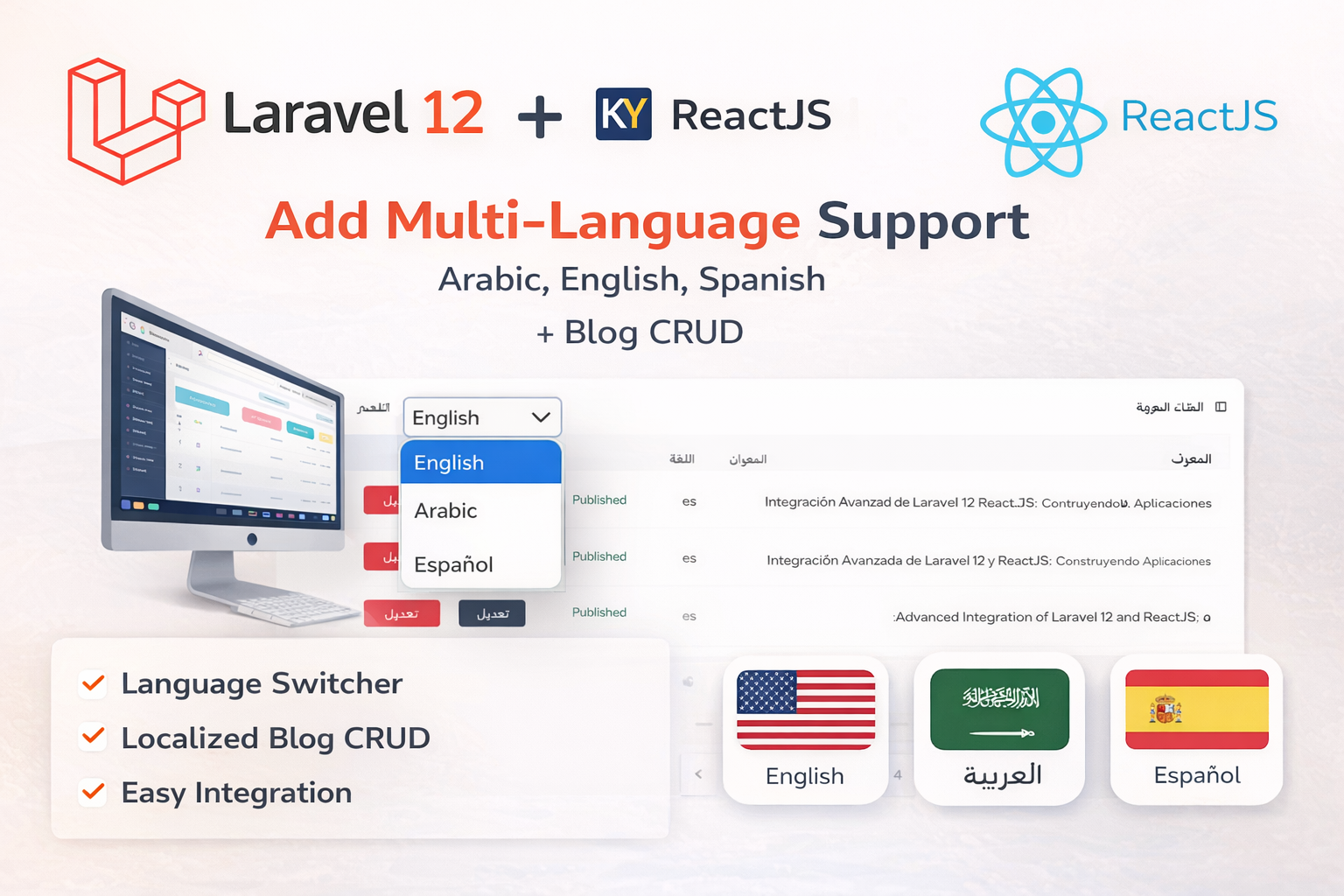
Laravel 12 + ReactJS Starter Kit: Add Multi-Language Support (Arabic, English, Spanish) with Blog CRUD
🚀 Installation & Setup Download & Extract Get the ZIP from kritimyantra.com and extract it. Includes preconfigu...
AI Can Build a Laravel App in Minutes. But Can It Maintain One for Five Years?
AI is making software development faster. But the real test of a Laravel application isn't how quickly it can be generated. It's w...
8 Years With Laravel: What AI Coding Still Gets Wrong
AI can write Laravel controllers, generate migrations, build APIs, and even troubleshoot complex applications. But after eight yea...

PHP Isn't Dead. AI Might Give It a Second Life.
AI is changing how software gets built. But the biggest opportunity for PHP might have less to do with generating code and more to...

Laravel 14 isn't here yet. But you can already build serious AI agents with Laravel today.
Laravel 14 is on the horizon, but the foundations of AI-native development are already here. Here's how I'd architect a Laravel AI...
Preparing for Laravel 14: PHP 8.4, Symfony 8, and Breaking Changes You Can Investigate Now
The next Laravel upgrade is not just about framework compatibility. It is an opportunity to discover how much your application dep...
Laravel 14 Release Date: What's Confirmed for 2027
Laravel 14 is already being discussed, but there is an important difference between knowing when a framework is likely to arrive a...
Comments
No comments yet. Be the first to comment.
Sign in to join the discussion.