
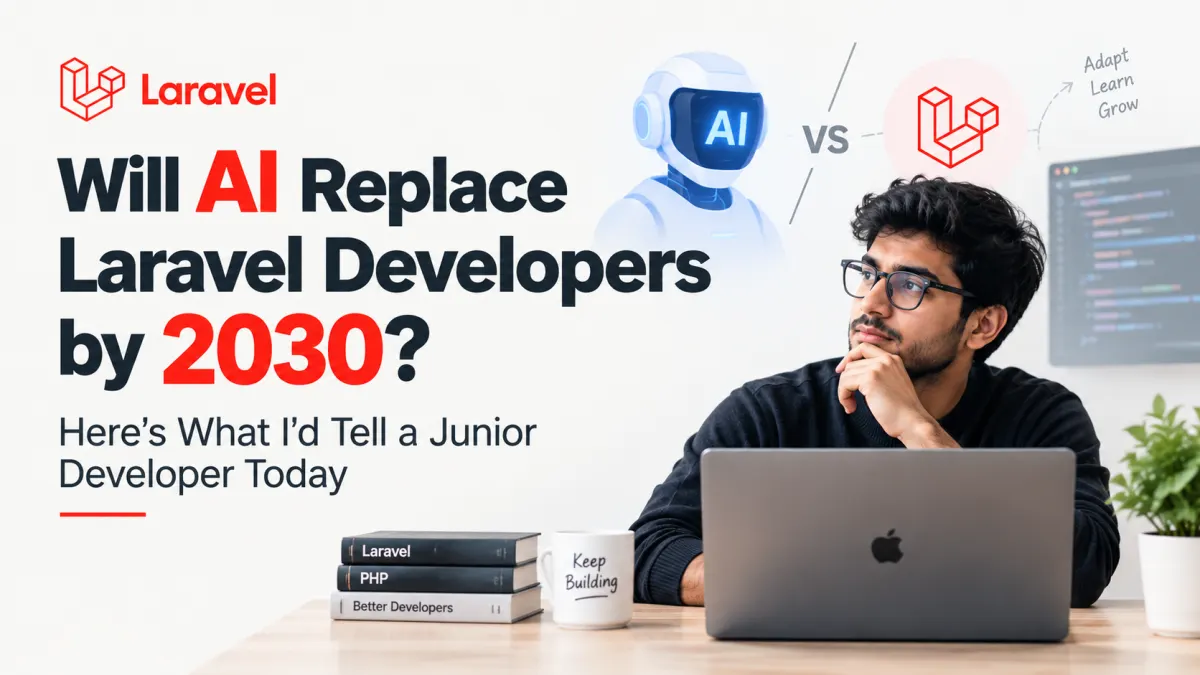
Will AI Replace Laravel Developers by 2030? Here's What I'd Tell a Junior Developer Today

An AI coding agent can generate a Laravel controller, Eloquent model, migration, API resource, and a reasonable first draft of the tests before a developer has finished reviewing the requirements.
That's impressive. It's also where the difficult questions begin.
Does the endpoint enforce the correct permissions? What happens when two requests update the same record? Will a failed queue job cause duplicate operations? Can someone maintain the generated code six months later?
These questions explain why I don't believe the future of Laravel development is simply about humans competing with AI to write PHP faster.
By 2030, AI could replace a substantial amount of the work Laravel developers currently perform. Whether that translates into fewer developers, different jobs, or more software being built is a much harder question.
If a junior developer asked me whether Laravel was still worth learning, my answer would be yes—but I would recommend learning it differently than developers did a decade ago.
What AI Will Probably Take Over in Laravel Development
Let's acknowledge what has already changed.
AI tools are increasingly capable of handling work that once occupied a significant portion of a developer's day.
Consider a typical Laravel application. A developer needs to create a customer management module containing database migrations, relationships, validation, CRUD endpoints, authorization rules, and tests.
Much of the initial implementation follows familiar framework conventions.
Given sufficiently clear requirements and appropriate repository context, an AI agent can generate substantial portions of that module.
The areas most exposed to automation include:
CRUD development: Generating controllers, models, migrations, API resources, and routine validation.
Test scaffolding: Drafting feature tests, factories, and common success and failure cases.
Code maintenance: Suggesting refactoring changes, updating repetitive patterns, and explaining unfamiliar code.
Documentation: Producing API descriptions, implementation summaries, and initial technical documentation.
Debugging assistance: Exploring stack traces, identifying possible causes, and proposing fixes.
This is meaningful automation. Pretending AI can only generate trivial boilerplate would underestimate how quickly coding tools are progressing.
However, generating code and improving engineering productivity are not the same thing.
Research from METR illustrates the difficulty of measuring that difference. An experiment conducted in early 2025 found experienced open-source developers completed tasks more slowly when using the AI tools available at that time.
In a February 2026 research update, METR reported signs that newer tools were improving productivity, but participant and task-selection biases prevented a reliable estimate of the improvement.
A separate May 2026 METR survey found that 349 technical workers reported substantial increases in the value of their work from AI. Those were self-reported estimates, not experimentally verified gains, and the participants were not exclusively Laravel developers.
The evidence is evolving, and so are the tools.
My expectation is that routine implementation will become increasingly automated. A developer whose primary contribution is translating straightforward requirements into conventional framework code will face more pressure.
But a Laravel developer's responsibilities should extend far beyond producing conventional framework code.
The Laravel Skills That Become More Valuable When AI Writes the Code
Imagine an AI agent generates an endpoint allowing users to update customer orders.
The controller validates the request, finds the order, updates its status, and returns a JSON response.
Everything looks reasonable.
Now consider the actual business requirements.
Only authorized employees should modify orders. An order that has already shipped cannot return to a pending state. A payment operation must not execute twice because a request was retried. Inventory updates must remain consistent when multiple requests arrive simultaneously.
Suddenly, the controller is the simplest part of the problem.
Business rules and architectural decisions
Laravel makes it relatively straightforward to organize application behavior through controllers, services, jobs, events, and other framework features.
Choosing how those components should interact is still an engineering decision.
For example, should an order-status change trigger a queued notification? Should that job be dispatched only after the database transaction commits? What happens when the notification provider is unavailable?
An AI agent can propose implementations for each of these decisions.
The developer must determine which behavior the business actually requires, which failures are acceptable, and how the system should recover.
That's where knowledge of application architecture becomes valuable.
Security and data integrity
A generated endpoint might authenticate a user correctly while still exposing records belonging to another customer or organization.
Authentication establishes who the user is. Authorization determines what that user is permitted to do.
Laravel provides gates and policies for authorization, but their presence alone does not guarantee that business-specific access rules are correct.
Developers need to understand tenant isolation, request validation, sensitive-data handling, database constraints, and privilege boundaries.
A passing happy-path test is not sufficient evidence that an application is secure.
Production reliability
A feature isn't finished just because it works locally.
Applications need appropriate database indexes, reliable queue processing, meaningful logging, safe deployments, and recovery procedures.
A seemingly harmless query can introduce an N+1 performance problem. An unguarded retry can repeat an external side effect. A migration that works against a small development database can become operationally risky against a busy production table.
AI can help identify these problems, but the team deploying the application still needs a way to detect, prevent, and recover from them.
This distinction is important for businesses, too.
Faster code generation does not automatically mean cheaper software delivery. The cost of reviewing, correcting, integrating, securing, and maintaining generated code must be included.
The 2025 DORA State of AI-assisted Software Development report describes AI as an amplifier of an organization's existing strengths and weaknesses.
That is a useful way to think about AI adoption: strong engineering practices make automation more useful, while weak practices can allow mistakes to accumulate faster.
The Laravel developer who can verify, integrate, and maintain AI-generated code may create more value than the developer who simply generates the most code.
Will There Be Fewer Laravel Developer Jobs by 2030?
Possibly. I wouldn't dismiss that risk.
If AI allows a small team to deliver the same workload with fewer people, some organizations will decide not to replace departing developers or expand their teams.
Junior positions focused on repetitive implementation could be particularly vulnerable.
But there's another possible outcome.
When building software becomes less expensive, companies may choose to build applications they previously couldn't justify: internal tools, customer portals, integrations, specialized workflows, and smaller digital products.
Lower development costs can reduce demand for certain tasks while increasing demand for software overall.
Both forces can operate simultaneously.
That's why I would avoid predictions such as "Laravel developers will disappear by 2030" or "AI will never replace real engineers."
Neither is supported by enough evidence to be treated as a reliable forecast.
Three changes seem more plausible.
First, the definition of a productive developer will change. Writing code quickly will matter less as a differentiator. Understanding requirements, designing solutions, and delivering reliable features will matter more.
Second, teams may become smaller or differently structured. Developers who can work across application architecture, databases, integrations, testing, and deployment will be useful when coordinating AI-assisted implementation.
Third, junior developers may have a harder time gaining experience. Historically, smaller implementation tasks provided opportunities to understand a codebase and learn from code reviews. If those tasks are increasingly automated, engineering leads will need to create more deliberate learning opportunities.
This last point deserves attention.
A business cannot expect to hire experienced engineers indefinitely without creating opportunities for less experienced developers to become experienced.
Junior developers will need to demonstrate useful judgment earlier, but companies will also need to invest in mentorship, debugging practice, and meaningful technical ownership.
By 2030, I expect there will still be work for Laravel engineers. I am much less confident that the traditional route into that work will remain unchanged.
The Six-Month Learning Path I'd Recommend to a Junior Laravel Developer
I wouldn't advise a junior developer to abandon Laravel and spend six months learning only AI prompting techniques.
I'd recommend building one increasingly realistic application, using AI as an assistant while deliberately developing the ability to evaluate its output.
For this exercise, imagine a multi-tenant support-ticket application: organizations have users, users create tickets, and authorized employees manage ticket statuses and responses.
The objective isn't to produce a polished portfolio screenshot. It's to demonstrate engineering competence.
Month 1: Understand PHP and Laravel without relying on generated code
Build the basic application yourself.
Implement models, migrations, relationships, controllers, validation, routing, and an API or simple interface.
Understand PHP types, exceptions, interfaces, dependency injection, and how an HTTP request moves through Laravel.
Use the framework documentation as your primary reference. Ask AI to explain unfamiliar concepts, but avoid accepting implementations you cannot explain.
Deliverable: A functioning application whose request flow and database structure you can explain from memory.
Month 2: Learn authorization and database boundaries
Introduce multiple organizations and users with different permissions.
Ensure users cannot access another organization's tickets by changing a route parameter or API request.
Write authorization policies and tests covering both allowed and forbidden actions.
Study foreign keys, indexes, Eloquent relationship loading, and query behavior.
Deliverable: Automated tests demonstrating that organization boundaries and role-based permissions are enforced.
Month 3: Handle failures and background processing
Add notifications through Laravel queues.
Explore what happens when a job fails, retries, or runs more than once. Design the notification workflow so retries do not create unacceptable duplicate side effects.
Practice database transactions and understand when work involving external systems cannot simply be rolled back.
You don't need to introduce a real payment provider to learn these concepts.
Deliverable: A background-processing feature with documented retry behavior and tests for important failure cases.
Month 4: Become comfortable testing and debugging
Write feature tests for ticket creation, updates, authorization, and invalid state transitions.
Use database query inspection to identify inefficient queries. Add relevant indexes and compare query plans where appropriate.
Practice debugging before asking AI for the answer. Form a hypothesis, inspect the evidence, and test a fix.
Then compare your diagnosis against an AI-generated suggestion.
Deliverable: A meaningful test suite and a short explanation of a performance or correctness problem you investigated.
Month 5: Learn what production ownership involves
Deploy the application into a controlled environment.
Configure environment variables, queue workers, scheduled tasks, logging, and error reporting.
Understand HTTPS, secrets management, database backups, migration risks, and basic rollback procedures.
Practice recovering from an intentionally failed deployment or background job.
Deliverable: A deployed application with documented setup, monitoring, backup, and recovery procedures.
Month 6: Use AI like an engineer, not a shortcut
Now use an AI coding assistant deliberately.
Choose two comparable features. Implement one primarily through your own coding process and the other with substantial AI assistance.
Track the complete effort, including prompting, generation, review, debugging, testing, and rework.
Don't send production secrets, customer information, or unauthorized proprietary code to external tools.
Review generated migrations, policies, queries, dependencies, and tests as carefully as you would review another developer's changes.
Record where AI helped, where it introduced unnecessary complexity, and which decisions still required your understanding of the system.
Deliverable: A documented, maintainable application plus an honest assessment of your AI-assisted development process.
After six months, the goal is not to claim expertise in every part of Laravel.
It's to demonstrate that you understand the application well enough to make changes safely, explain trade-offs, identify failures, and use automation responsibly.
That is a stronger foundation than collecting AI-generated projects you cannot maintain.
What I'd Tell a Junior Developer Today
If you're learning Laravel because you enjoy building applications, I wouldn't discourage you.
But I would change what you optimize for.
Don't measure your progress by the number of controllers you've written or the number of packages you know how to install.
Measure whether you can take an ambiguous requirement, identify the risks, build an appropriate solution, verify its behavior, and explain why you made particular decisions.
Learn PHP properly. Understand SQL. Get comfortable with Laravel's internals, testing, security, queues, and deployment.
And learn AI tools. Refusing to use them entirely isn't a particularly strong career strategy either.
The important distinction is whether AI is extending your engineering capability or replacing the learning process you still need to go through.
My advice is to become the developer who knows what should be built, why it should work that way, and how to prove that it works.
By 2030, the amount of PHP written manually may be much smaller. The responsibility for delivering software that businesses can trust won't necessarily shrink with it.
That's the part of Laravel development I'd invest in.
Projects to explore next
Source-code projects from the KritiMyantra catalogue. Check each project's details before buying.
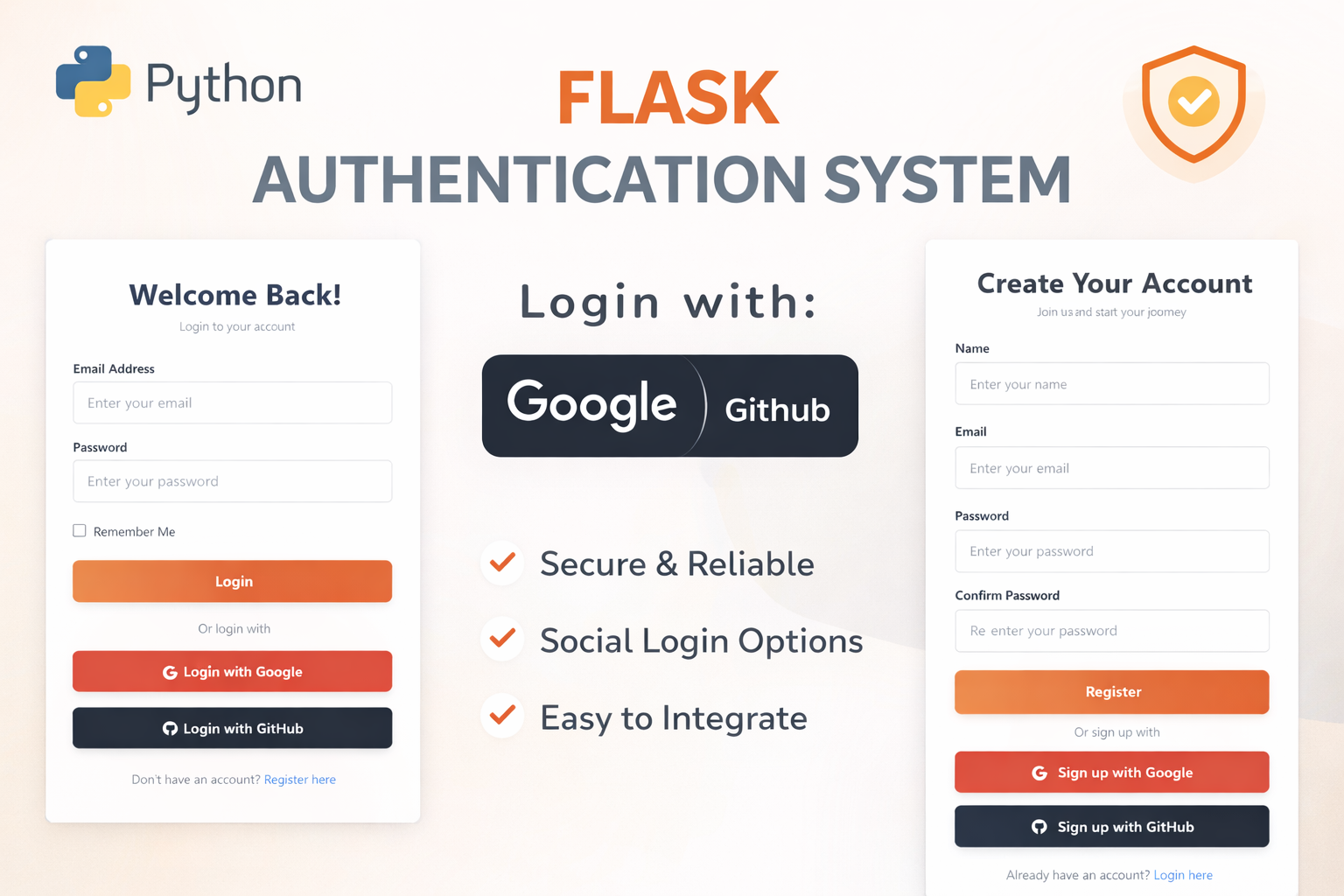
Flask Authentication System (Free Version) - Kritim Yantra
🛠 Features✔ Google & GitHub Authentication✔ User Registration & Login✔ Profile/Dashboard Access✔ Secure & Mi...

Flask Blog CMS with Admin Dashboard — Python Source Code
A Flask-based blogging website with a built-in admin dashboard. Manage articles, images, categories, tags and featured p...
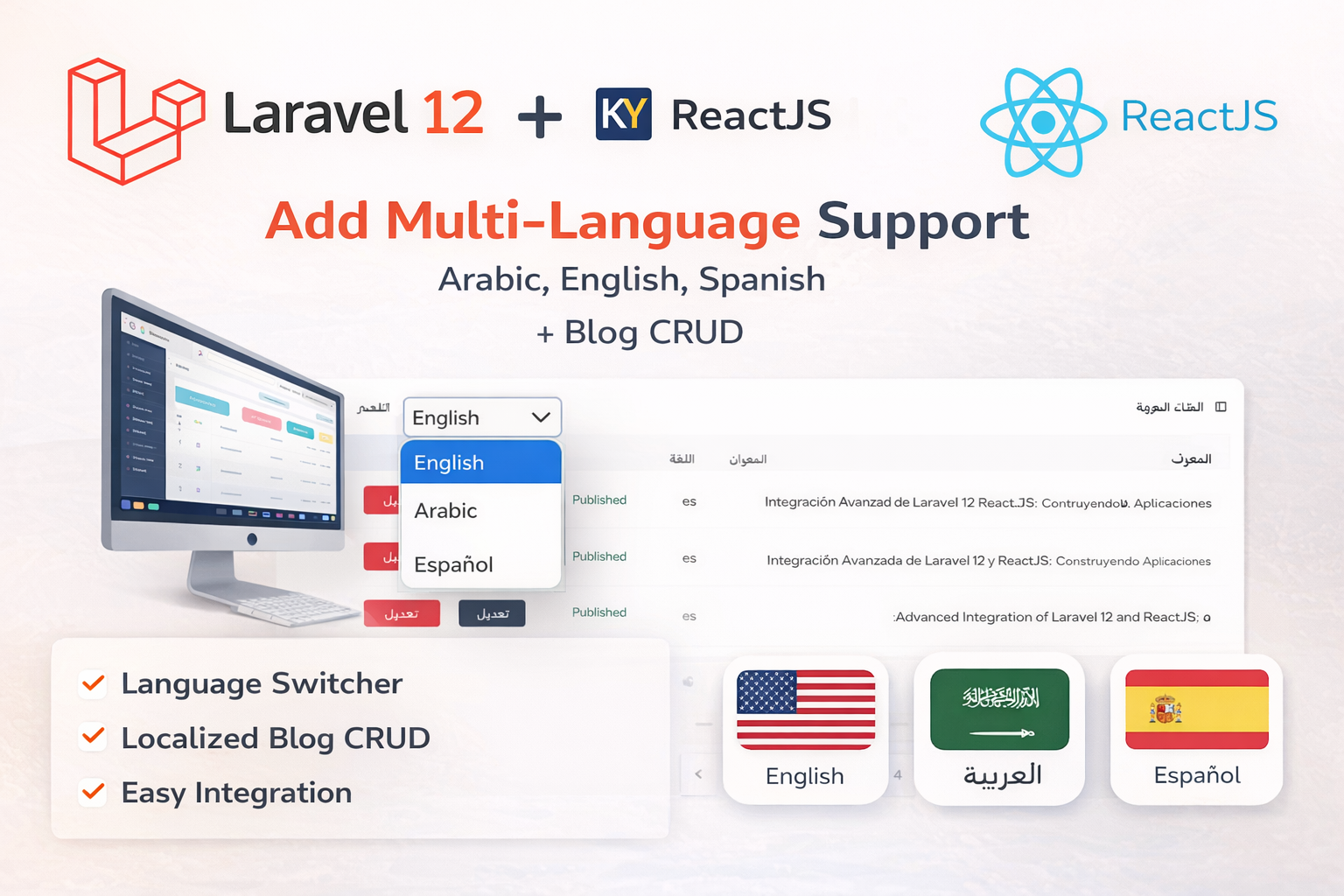
Laravel 12 + ReactJS Starter Kit: Add Multi-Language Support (Arabic, English, Spanish) with Blog CRUD
🚀 Installation & Setup Download & Extract Get the ZIP from kritimyantra.com and extract it. Includes preconfigu...
Laravel 14 isn't here yet. But you can already build serious AI agents with Laravel today.
Laravel 14 is on the horizon, but the foundations of AI-native development are already here. Here's how I'd architect a Laravel AI...
Preparing for Laravel 14: PHP 8.4, Symfony 8, and Breaking Changes You Can Investigate Now
The next Laravel upgrade is not just about framework compatibility. It is an opportunity to discover how much your application dep...
Laravel 14 Release Date: What's Confirmed for 2027
Laravel 14 is already being discussed, but there is an important difference between knowing when a framework is likely to arrive a...
Laravel 14 and PHP 8.4: Why Symfony 8 Matters
Laravel 14 is expected to raise its minimum PHP requirement to 8.4. At first glance, that might look like another routine version...
Laravel 14 Upgrade Risks: Eloquent, Queues and Cache
A Laravel application can pass its test suite, boot successfully after an upgrade, and still behave differently in production. An...
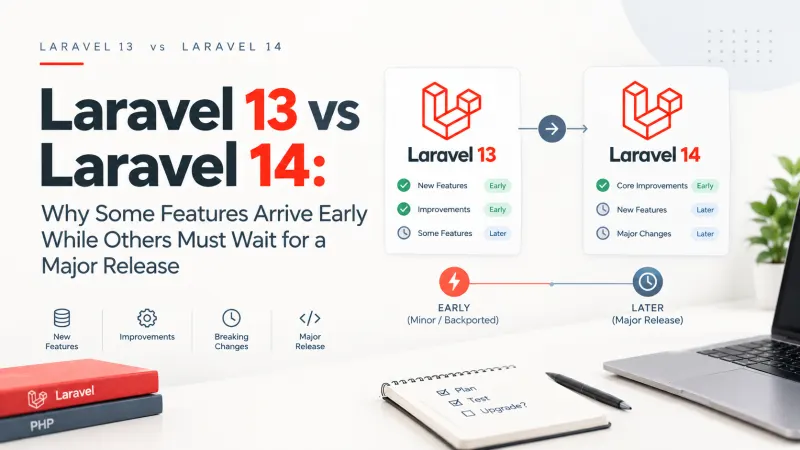
Laravel 13 vs Laravel 14: Why Some Features Arrive Early While Others Must Wait for a Major Release
One interesting thing about Laravel is that some genuinely useful features appear in ordinary framework updates, while seemingly s...
Comments
No comments yet. Be the first to comment.
Sign in to join the discussion.