
Flask Authentication System with Admin Panel - Kritim Yantra
Flask Auth Pro with Admin PanelA complete Flask authentication and user management system built for developers who want to start a real project without rebuilding login, registration, security and admin features from scratch.This is more than a basic...
Need help with this project?
The source code is a one-time purchase. These services are optional.
Installation & deployment
Application setup, database configuration and deployment to suitable hosting.
Customization
Branding, workflow changes, new features and integrations scoped to your needs.
Monthly maintenance
Agreed updates, troubleshooting and release support for an existing live site.
Enquiries are free. We confirm the scope and final cost before any paid work, including applicable hosting, third-party fees and taxes.
See the project before you download it
Open any screenshot at full size and browse using the arrows.
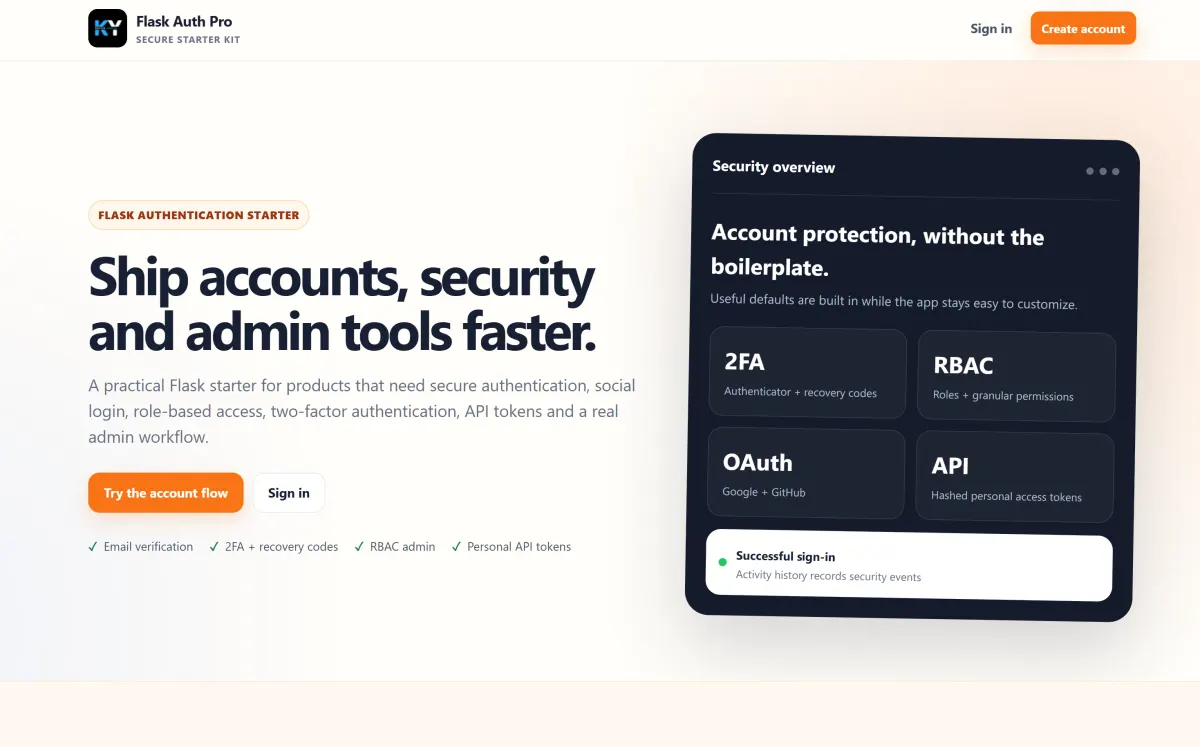
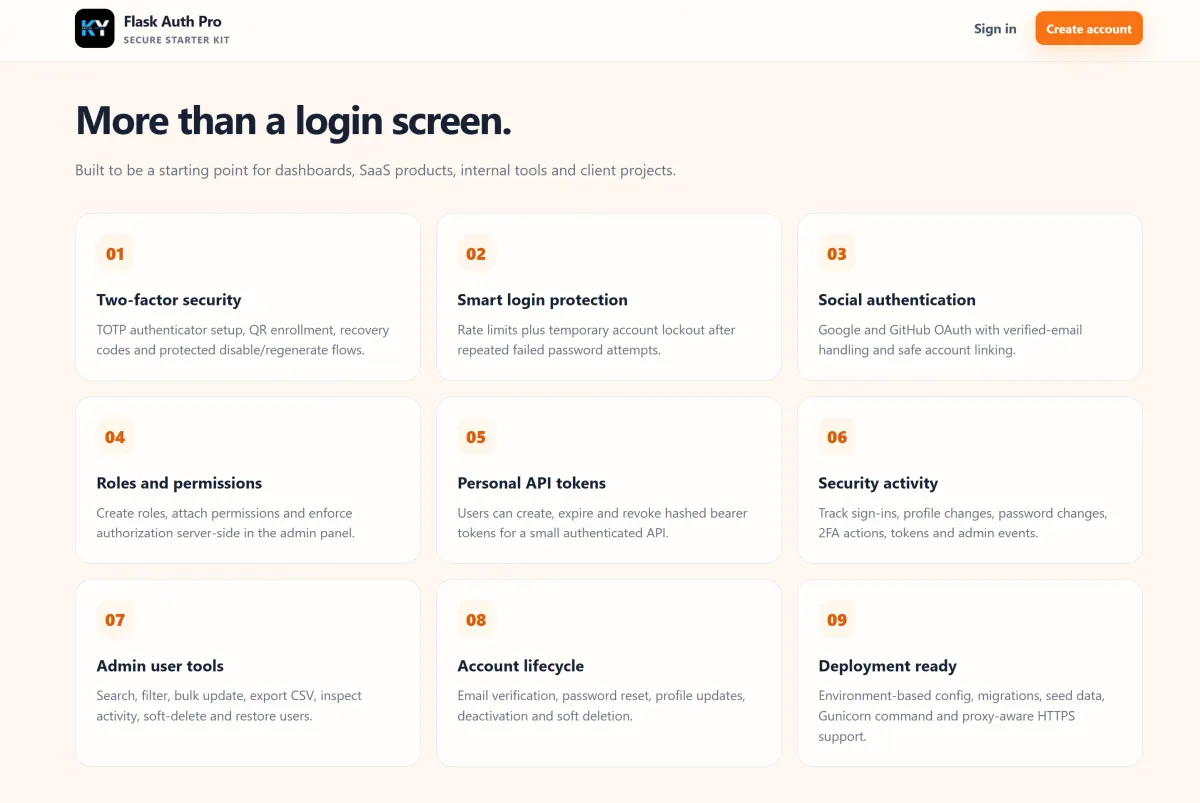
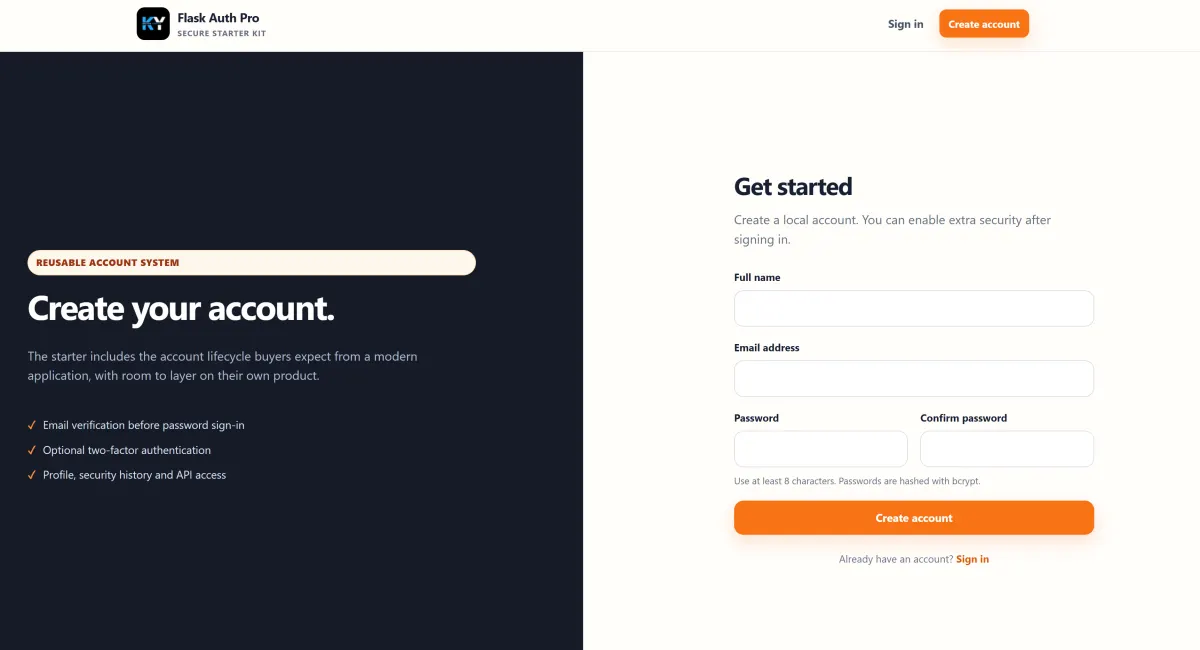
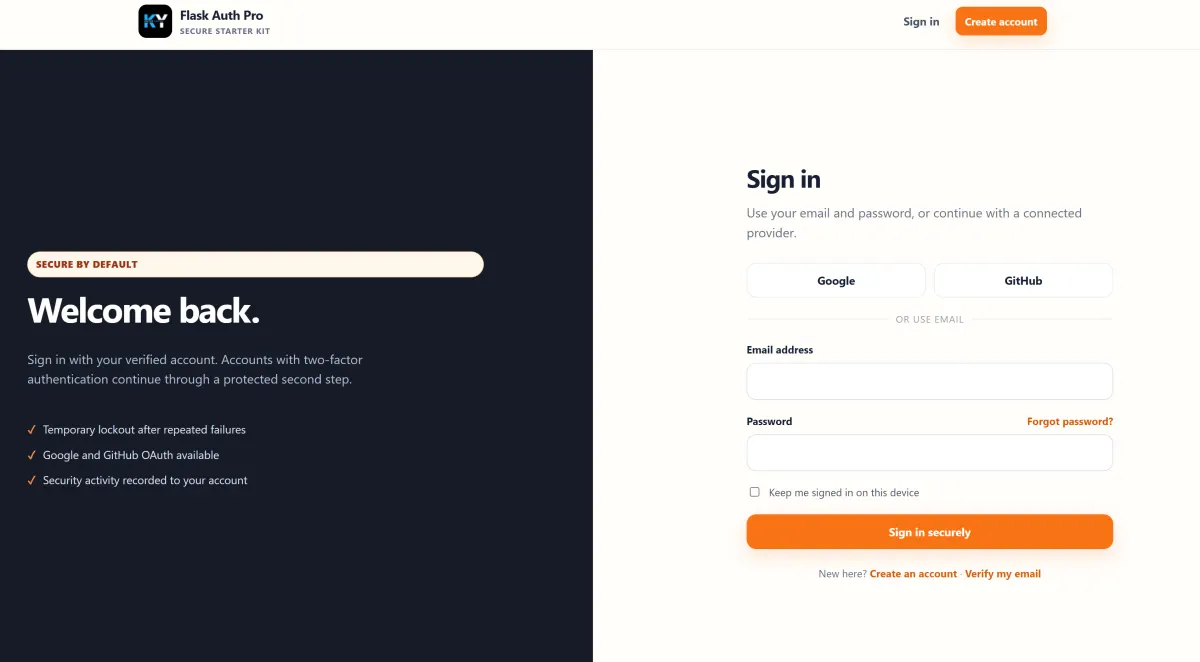
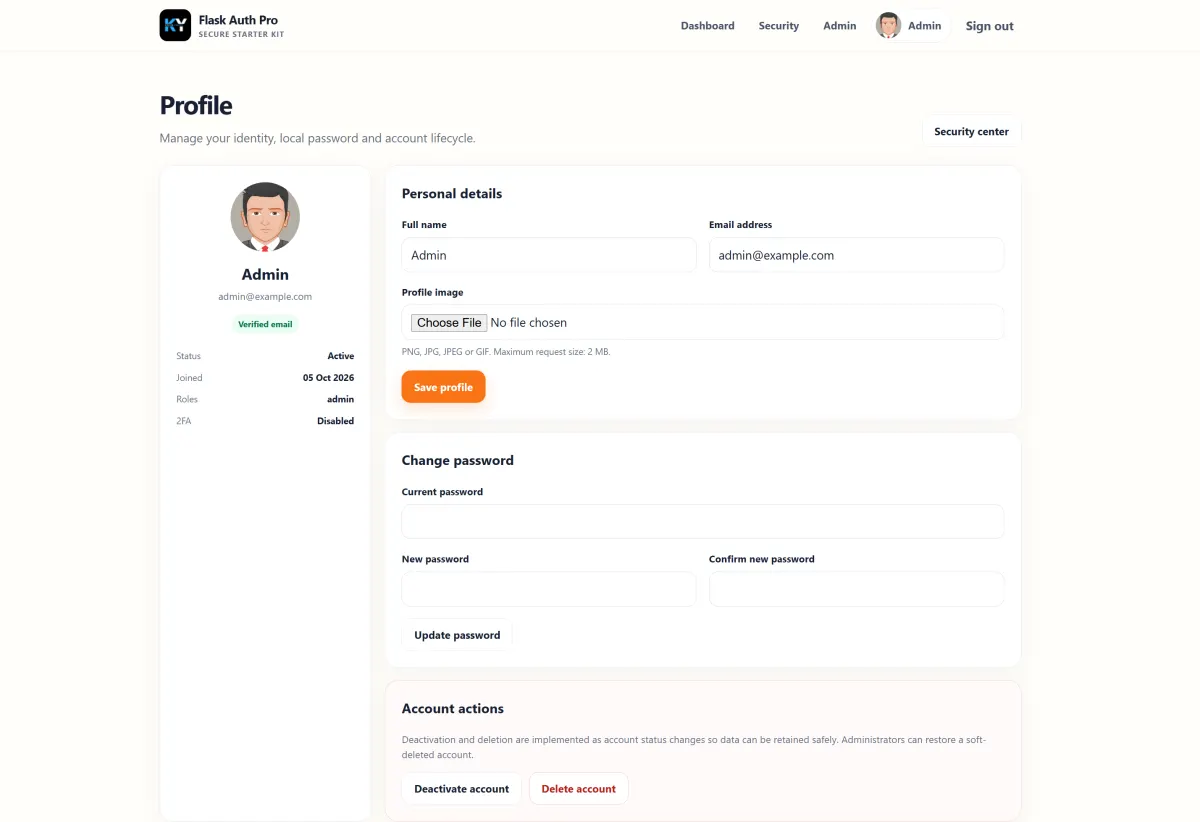
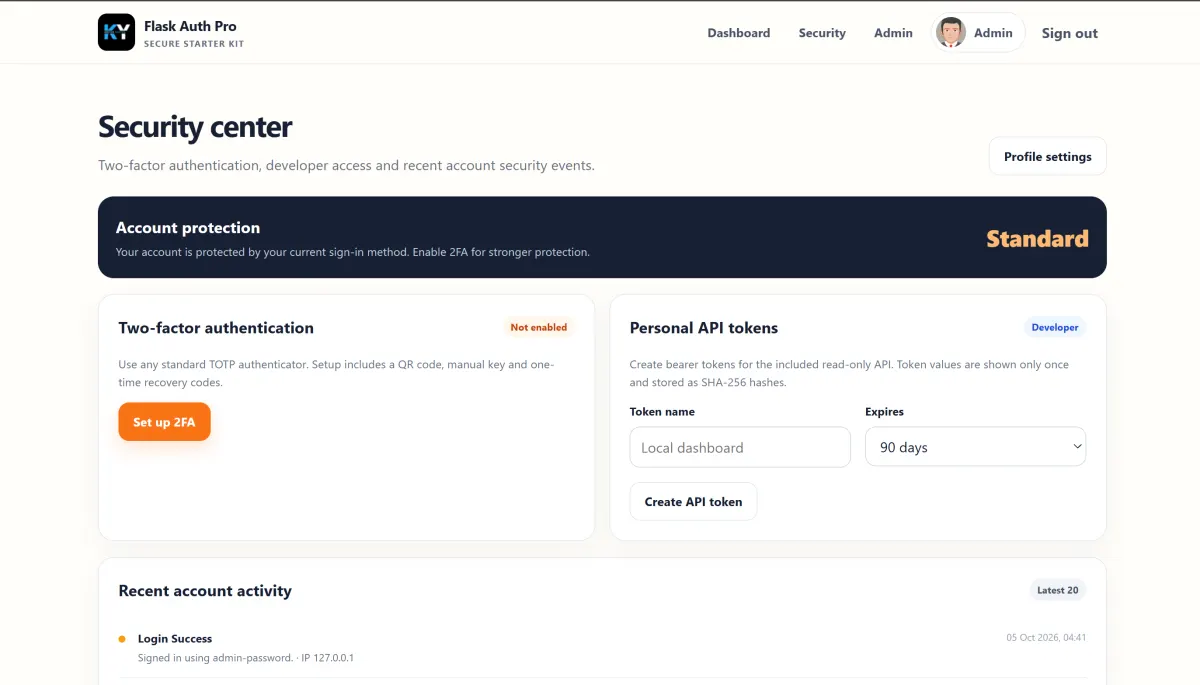
Project overview
What the project does, what you receive and what you'll need to run it.
Flask Auth Pro with Admin Panel
A complete Flask authentication and user management system built for developers who want to start a real project without rebuilding login, registration, security and admin features from scratch.
This is more than a basic login and signup demo. It includes a complete authentication flow, role-based access control, two-factor authentication, social login, API tokens, user management, security activity tracking and a full admin panel.
The source code is clean, structured and ready to customize for SaaS products, internal tools, client applications, dashboards, portals or your next Flask project.
What can you build with it?
Use it as the starting point for:
SaaS applications
Customer portals
Admin dashboards
Membership websites
Internal company tools
Flask APIs
Client projects
Subscription-based platforms
CRM or ERP applications
Any Flask application that needs secure user accounts
Instead of spending days building authentication, permissions, password recovery, email verification and admin tools, you can start with these important parts already working.
Authentication System
The project comes with a complete user authentication flow.
Users can:
Create an account
Sign in securely
Sign out
Verify their email address
Reset a forgotten password
Change their password
Update their profile
View recent account activity
Manage account security
Form validation, error handling and security checks are already implemented.
Two-Factor Authentication
Users can add an additional layer of protection to their account using authenticator applications.
The system includes:
TOTP-based two-factor authentication
QR code setup
Authenticator app support
Recovery codes
Recovery code regeneration
Secure 2FA verification during login
Ability to disable 2FA from account settings
This works well with apps such as Google Authenticator, Microsoft Authenticator and other standard TOTP applications.
Google and GitHub Login
Social authentication is already integrated using OAuth.
The project supports:
Sign in with Google
Sign in with GitHub
Automatic account creation
Existing account handling
OAuth configuration through environment variables
You only need to add your own OAuth credentials before using these services in production.
Role-Based Access Control
The application includes a proper roles and permissions system instead of relying on simple hard-coded admin checks.
You can create roles such as:
Admin
Manager
Staff
Customer
Member
Permissions can then be assigned according to what each type of user should be allowed to access.
This makes the project suitable for applications where different users need different levels of access.
Powerful Admin Panel
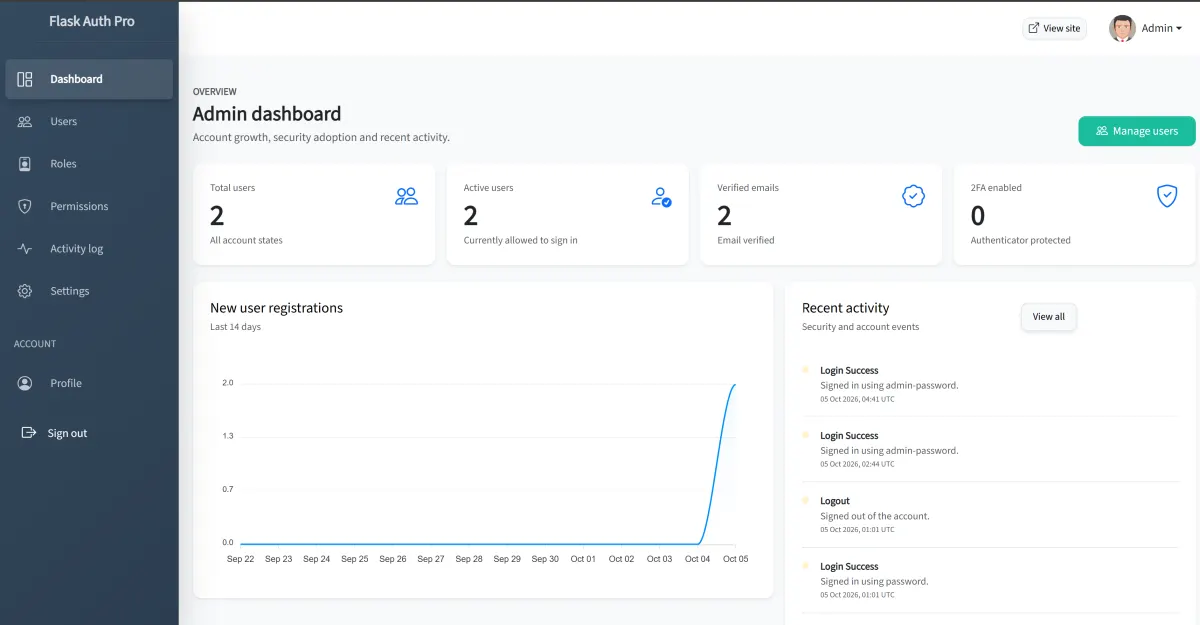
Administrators get a separate management interface for controlling users and monitoring the application.
The admin panel includes:
Dashboard statistics
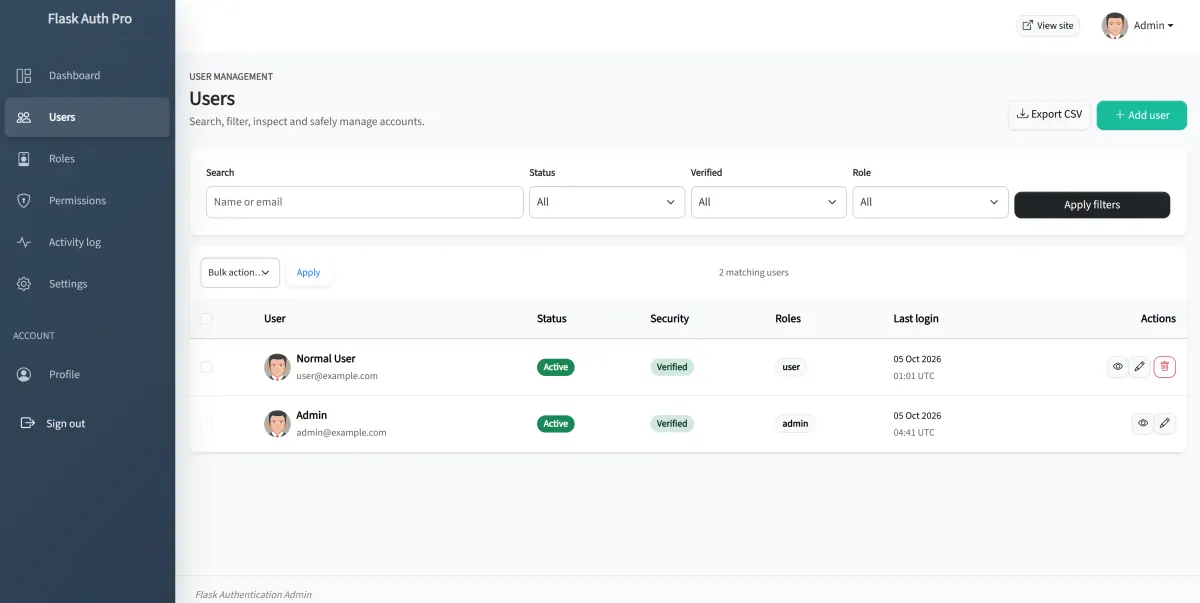
User management
Search users
Filter users by status
Filter by role
Filter by email verification status
View complete user details
Activate or deactivate accounts
Verify or unverify users
Edit user information
View user security activity
Soft-delete users
Restore deleted users
Bulk user actions
Export users to CSV
Role management
Permission management
Site settings
Built-in protections also prevent administrators from accidentally disabling important system accounts or roles.
Security Activity Tracking
Important account and administrative actions are recorded so you can understand what is happening inside the application.
Activity records can include:
Successful logins
Failed login attempts
Password changes
Password reset activity
Profile changes
Two-factor authentication changes
API token activity
Administrative actions
IP address
Browser / user-agent information
Date and time
Administrators can review security activity from the admin area, while users can view relevant activity from their own account.
Login Protection
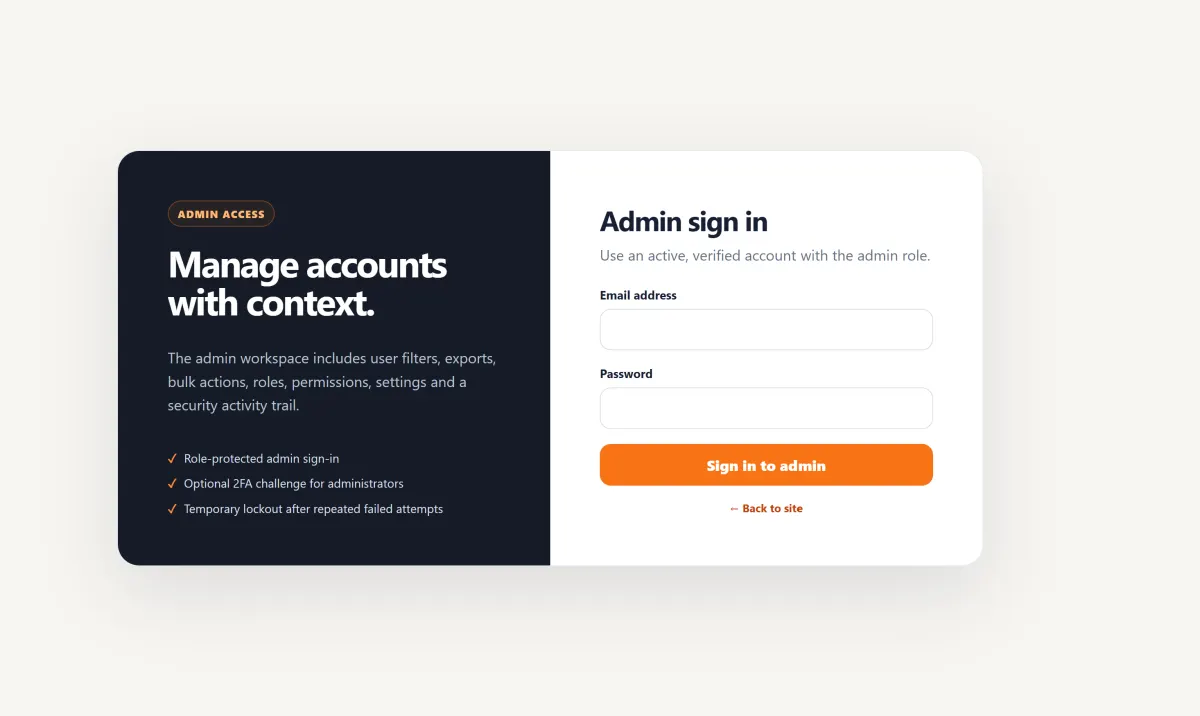
The authentication system contains protection against repeated failed login attempts.
Features include:
Failed login tracking
Configurable login attempt limits
Temporary account lockout
Secure password hashing
Session security
CSRF protection
Rate limiting
Security headers
No-store caching for sensitive account pages
These features give you a much stronger starting point than a simple tutorial authentication system.
Personal API Tokens
Users can create personal API tokens for applications that need programmatic access.
Token functionality includes:
Generate personal API tokens
Choose token expiration
30-day expiration
90-day expiration
365-day expiration
Non-expiring tokens
Revoke individual tokens
Token usage tracking
Secure hashed token storage
The raw API token is not stored directly in the database.
Example API endpoints are included for learning and extending the token authentication system.
REST API Examples
The project includes ready-to-use API examples such as:
GET /api/v1/health
Check whether the application is running.
GET /api/v1/me
Retrieve information about the authenticated API user.
GET /api/v1/activity
Retrieve account activity using token authentication.
These endpoints also provide a useful foundation if you want to build a larger REST API around the project.
User Dashboard
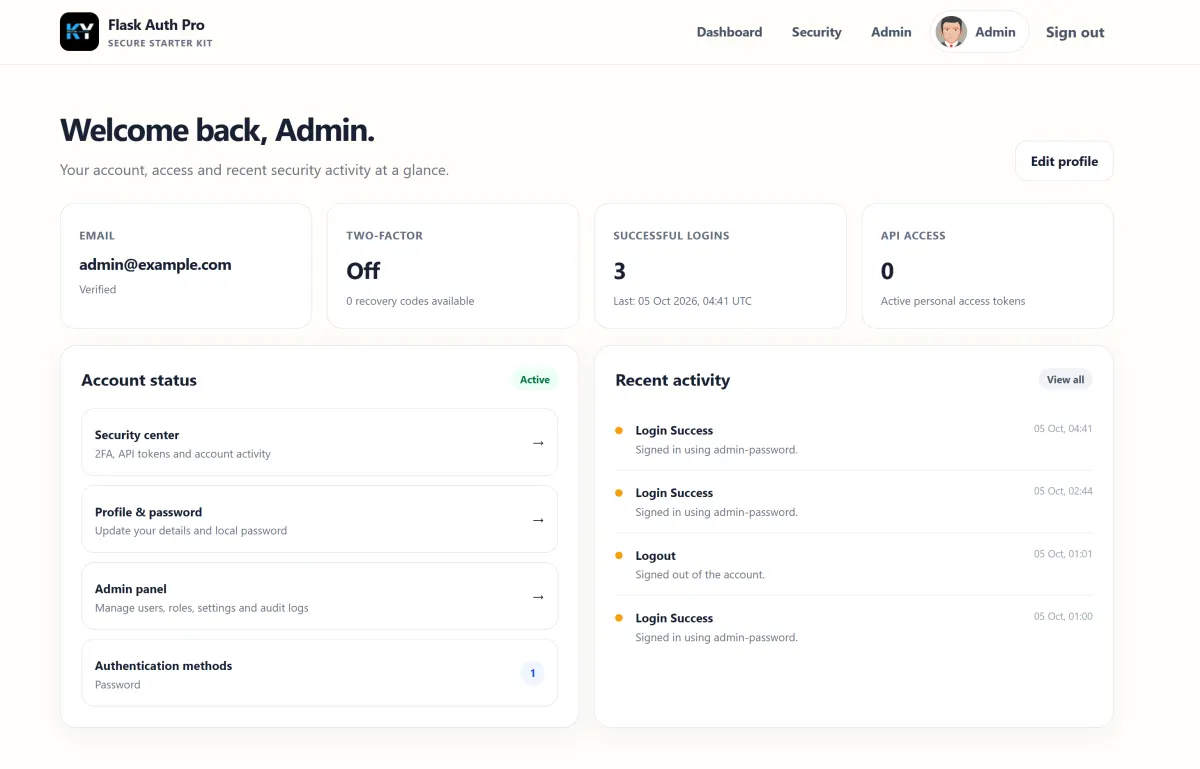
After signing in, users receive their own account dashboard.
From here they can access important account features such as:
Profile information
Account security
Password management
Two-factor authentication
Recovery codes
API tokens
Recent security activity
The interface is responsive and designed to be easy to customize for your own product.
Database Ready
Database migrations are already included.
The project can be used with SQLite for simple development and can also be configured for production databases such as:
MySQL
PostgreSQL
Separate dependency files are included where required.
A database seeder is also provided so you can quickly create the initial roles, permissions and sample accounts required to explore the system.
Email Support
Email functionality is built into the application for flows such as:
Email verification
Password reset
SMTP settings are managed through environment variables, making it easy to connect your preferred email provider.
Easy to Customize
The project is structured so you can use it as a foundation instead of having to rewrite everything.
You can customize:
Branding
Logo
Colors
Pages
Dashboard
User fields
Roles
Permissions
Email templates
Admin features
Database
API functionality
Authentication rules
It is suitable both for learning and for building a larger production application.
Technology Stack
Built with:
Python
Flask
Flask-SQLAlchemy
SQLAlchemy
Flask-Login
Flask-WTF
Flask-Migrate
Alembic
Authlib
Flask-Limiter
Flask-Mail
bcrypt
Jinja
HTML
CSS
JavaScript
The project also includes support files for MySQL, PostgreSQL and Redis-based rate limiting.
Clean Project Structure
The downloadable package includes the complete source code with an organized project structure.
You receive:
Application source code
Controllers
Routes
Models
Forms
Templates
Static assets
Database migrations
Seeder
Tests
Environment configuration example
Dependency files
Installation instructions
Deployment guidance
Troubleshooting guide
API guide
Admin guide
Security guide
PDF documentation
No real passwords, OAuth credentials, API secrets or production environment files are included.
You configure your own credentials using the provided .env.example file.
Documentation Included
You don't have to figure out the project structure on your own.
A detailed PDF guide is included with the download, along with separate developer-friendly documentation covering:
Quick start
Installation
Configuration
Database setup
Environment variables
Admin panel
Roles and permissions
API usage
Deployment
Customization
Security
Troubleshooting
The documentation includes Windows, macOS and Linux setup guidance.
Quick Installation
The basic installation process is straightforward:
python -m venv venv
pip install -r requirements.txt
Copy the provided environment example:
cp .env.example .envConfigure your database and application settings, then run:
flask --app run.py db upgrade
python seeder/run_seeder.py
python run.py
Detailed instructions are included with the download.
Who is this project for?
This project is useful for:
Developers
Skip repetitive authentication work and start building the actual features of your application.
Students
Study how authentication, database migrations, RBAC, OAuth, APIs and Flask application structure work together in a complete project.
Freelancers
Use it as a starting point for client portals, admin systems and custom web applications.
Agencies
Save development time when starting projects that require user accounts, permissions and administration.
Startup builders
Get the foundation of your application running before spending time on product-specific functionality.
What You Get
Your purchase includes the complete source code.
There are no encrypted or intentionally hidden application files.
You can study the code, modify it and build your own project on top of it according to the included usage terms.
Third-party services such as hosting, domains, email providers, Google OAuth and GitHub OAuth accounts are not included. You will need to configure your own credentials for any external services you choose to use.
Need Help Setting It Up?
If you can work with Python and Flask, the included documentation should be enough to get the project running.
If you would rather have someone handle the technical work, setup and customization support can also be requested separately.
Support can include:
Project installation
Server deployment
Database configuration
Google/GitHub OAuth setup
SMTP/email setup
UI changes
Feature customization
Bug fixing
New modules
API development
Ongoing maintenance
That means you can use the source code as-is, customize it yourself, or use it as the starting point for a larger application.
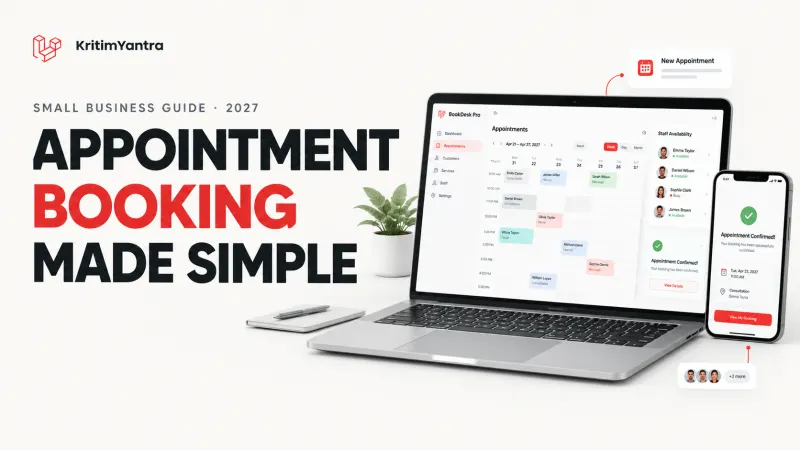
Online Appointment Booking Systems for Small Businesses: A 2027 Guide
For a salon, tutor, consultant, wellness studio or repair business, an empty appointment slot is more than a gap on the calendar....

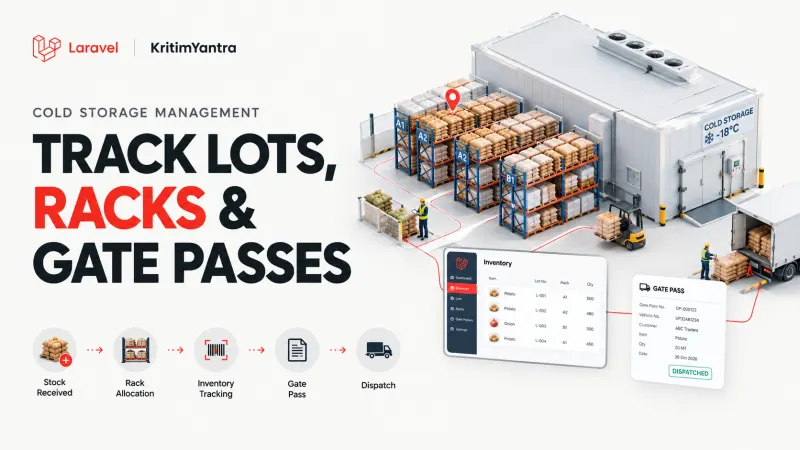
Cold Storage Inventory Management: Track Lots, Racks & Gate Passes
When a customer arrives to collect 60 bags of potatoes, your warehouse team should know exactly where those bags are stored. Nobod...
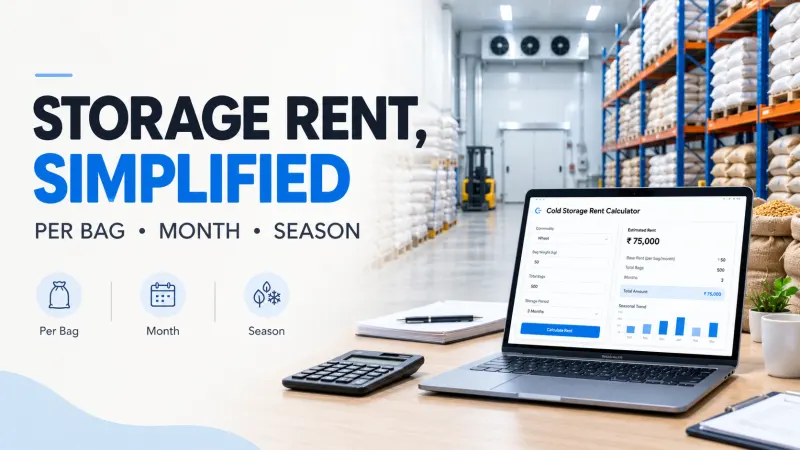
Cold Storage Rent Calculation Made Simple: Per Bag, Monthly & Seasonal Rates
Calculating cold storage rent shouldn't be more complicated than managing the stock itself.But anyone who runs a cold storage faci...
 Web Development
Free
Preview
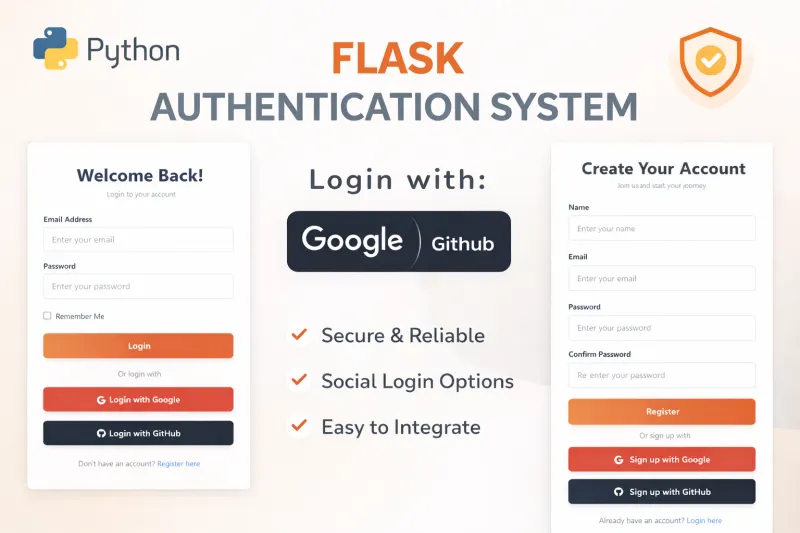
Flask Authentication System (Free Version) - Kritim Yantra
🛠 Features✔ Google & GitHub Authentication✔ User Registration & Login✔ Profile/Dashboard Access✔ Secure...
 Web Development
Member deal
Preview
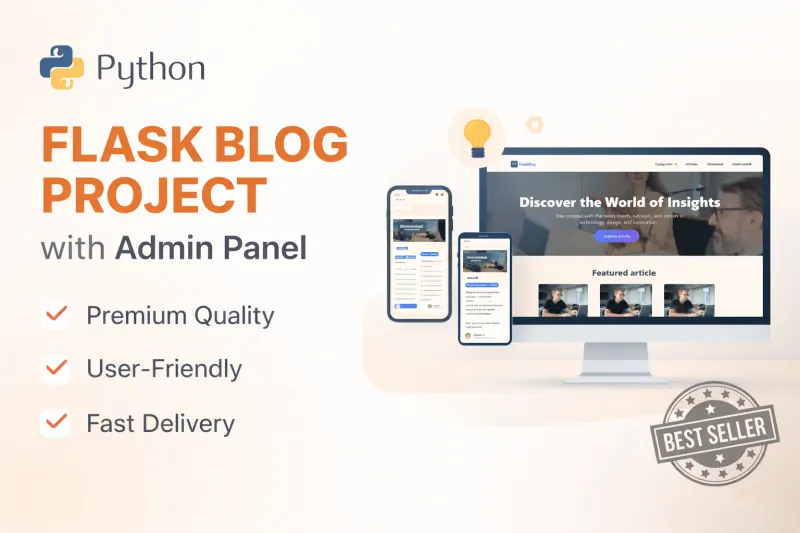
Flask Blog CMS with Admin Dashboard — Python Source Code
A Flask-based blogging website with a built-in admin dashboard. Manage articles, images, categories, tags and fe...
 Web Development
Member deal
Preview
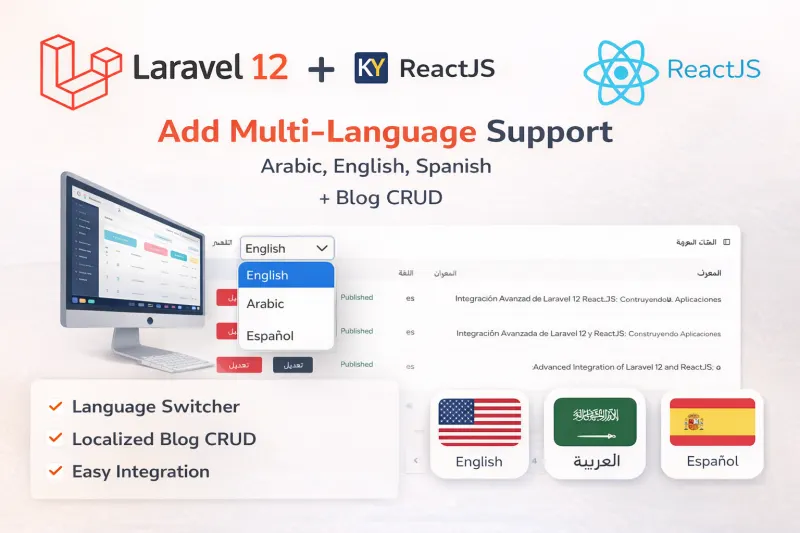
Laravel 12 + ReactJS Starter Kit: Add Multi-Language Support (Arabic, English, Spanish) with Blog CRUD
🚀 Installation & Setup Download & Extract Get the ZIP from kritimyantra.com and extract it. Includes pr...